
Child labour in the domestic sector is one of the most invisible forms of child labour. In many cases, it is hidden within households, beyond the reach of labour inspection and social protection systems. It also disproportionately affects girls and adolescent women, perpetuating the sexual division of labour and limiting their access to education and other opportunities, both present and future.
For the International Labour Organisation (ILO) and the Child Labour Free Latin America and the Caribbean Regional Initiative*, focusing on this issue is fundamental to design solutions that remove children from child labour and guarantee their rights.
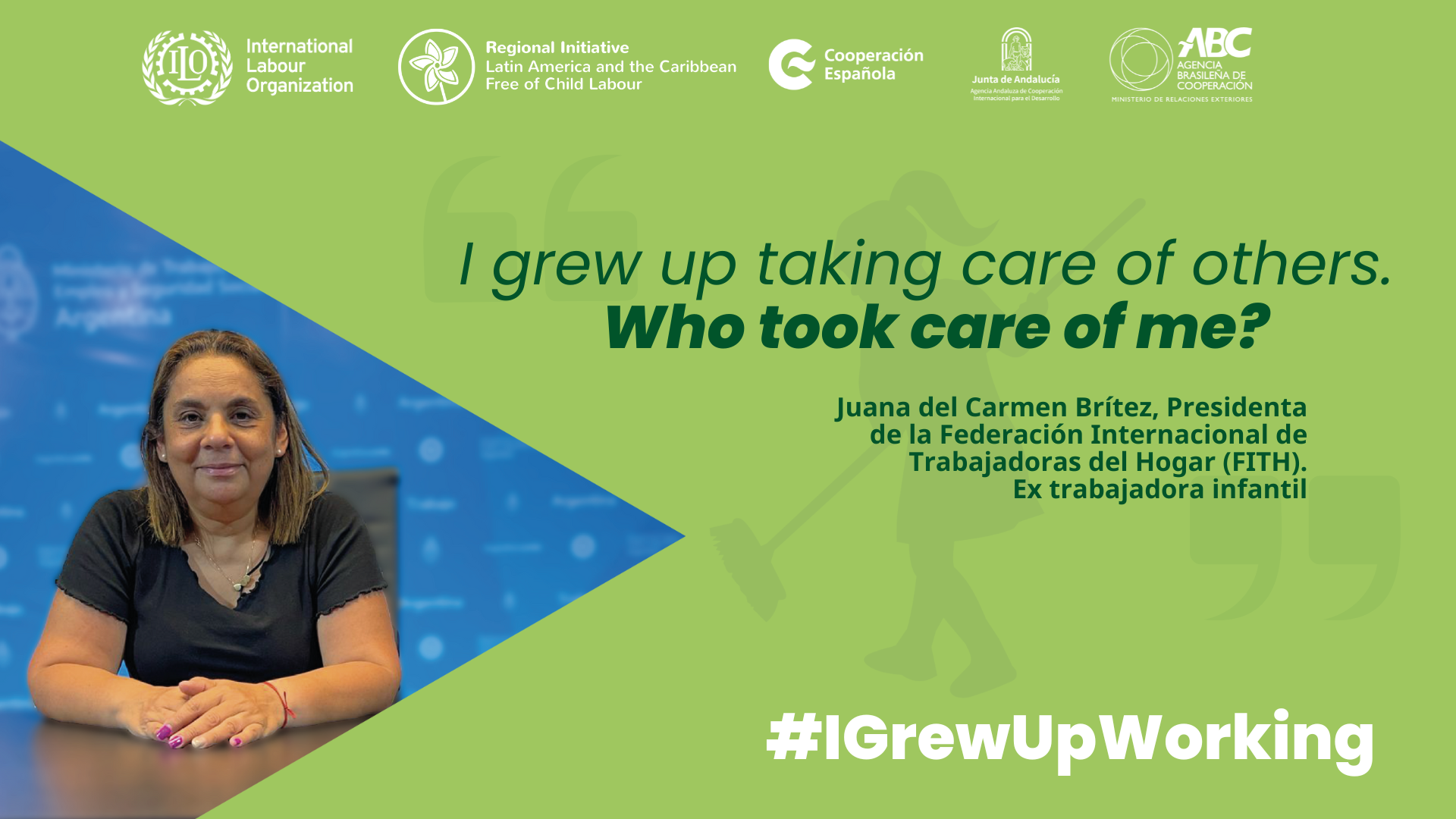
Juana del Carmen Brítez, union leader and former child labourer, shares her story of struggle and resilience.
Interviewed:
Juana del Carmen Brítez (Buenos Aires, Argentina) is President of the International Domestic Workers' Federation (FITH), heads the Unión Personal Auxiliar de Casas Particulares (UPACP) in Argentina and is Director of health care provision at OSPACP (Obra Social del Personal Auxiliar de Casas Particulares). She is a lawyer and has spent 35 years fighting for the rights of domestic workers, putting the issue on the social agenda of Argentina, the ILO, UN Women and other international organisations.
A childhood marked by work
Child domestic work usually begins in childhood, often out of necessity and in conditions that violate fundamental rights. Juana del Carmen Brítez experienced it first-hand.
"When I was 9 years old, my mother told us she was going to the greengrocer's and never came back. As the older sister, I was left to raise my two brothers aged 7 and 5. My dad worked in construction and we hardly saw him. Managing the household, cooking, cleaning and taking care of the money was my reality since I was a child.
My siblings and I moved as a team: to school, to the club, on the train... always looking out for each other. When my mother returned - years later - and three more siblings were born, I had to leave secondary school to work as a domestic worker in a third party household (both in the house and in the family business). Thus, I experienced two forms of child labour: first within my own household and then for another family".
The sexual division of child labour
From childhood, the sexual division of labour determines differences that disproportionately affect girls: it is they who assume the greater burden of domestic and care work, in contrast to their male counterparts. These barriers, in adulthood, restrict women's economic, social and political autonomy and perpetuate gender inequalities.
"I didn't play with dolls; I was a mother to my siblings before I was a child. I didn't know the cinema until I was 18. My dad told me that when I grew up, I was going to have to support him. Why me and not my brothers? Because I was a woman?".
From child labour to the trade union struggle
The organised struggle has been key to improving the conditions of domestic workers. However, it is still a sector with high levels of informality and vulnerability.
"Since I was a child I was called 'perica' because I spoke like an adult and defended others. When my brother was forced to do his military service without receiving his salary, I went at the age of 18 to claim for him, as if I were a lawyer (although I wasn't). I also witnessed how my mother was fired from her job when she was pregnant, I heard stories of female colleagues without rights and my dream to fight grew.
I became involved in the union at a very young age, and a few years later we managed to recover the social work for domestic workers (which allows us to provide health services for the workers and their families). At the age of 38, thanks to the impetus of the union, I decided to finish high school and then I graduated as a lawyer. Today I fight to ensure that no girl lives what I lived through".
Tripartite co-responsibility to make progress against child domestic labour
The eradication of child labour remains a challenge, but Argentina has made significant progress thanks to tripartite and coordinated action.
Employers, workers and the state participate in a tripartite roundtable that meets every two months to discuss labour improvements. Thanks to this space for dialogue, a 30% wage increase has been achieved in high-cost-of-living areas, directly benefiting thousands of women workers and their families.
The Unión Personal Auxiliar de Casas Particulares is also part of the Provincial Commission for the Prevention and Eradication of Child Labour (COPRETI) and trains trainers in understanding child labour in the domestic sector.
These advances have been key to strengthening the rights of domestic workers and creating a more protected environment for girls and adolescents. The approval of the Domestic Workers' Law in Argentina and the ratification of ILO Convention 190 on violence and harassment at work are fundamental steps that not only guarantee better working conditions, but also prevent the early incorporation of girls into child labour, ensuring their right to education and development.
The biggest challenges: recognising the value of domestic work and eradicating the employment of girls in households
In many sectors of society, domestic and care work is not sufficiently valued or recognised as work. As a result, adult domestic workers do not receive the recognition and labour rights they deserve, while girls are burdened with responsibility that is not theirs, instead of living their childhood with rights. The big challenge is to change this perception.
"We are not "part of the family", we are professionals providing a service. If we domestic workers were not here, how would employers make a living?".
For Juana del Carmen Brítez, the state's responsibility to guarantee education for all children and support for working mothers has yet to be strengthened. In addition, it is essential to raise awareness so that employers recognise domestic work as formal employment and stop hiring girls in their homes.
"So that no girl child has to repeat my story, the state must guarantee (i) education for all children and (ii) support for working mothers. If I have to go out to take care of other people's children, who takes care of mine? If I grew up taking care of others, who took care of me?".
On the other hand, it is crucial that society, especially employers, stop normalising child domestic labour. To eradicate this practice, awareness-raising campaigns and effective regulations are needed.
"Why is it that a girl from the employing household can study, but the working girl has no such right?".
In addition, strengthening labour inspection is crucial. Because domestic work takes place within households, it is easily invisible and beyond the reach not only of the labour inspectorate but also of social protection systems. Ensuring its regulation is a key step towards eradicating child labour in the sector.
Regional engagement on child domestic labour
Child domestic labour is one of the most difficult forms of child labour to eradicate due to its invisibility and the normalisation of these practices in the home. From the ILO and the Latin America and Caribbean Regional Initiative, we reaffirm our commitment to the eradication of child labour in all its forms, promoting the detection and visibility of this problem and promoting comprehensive public policies that focus on working girls.
Juana's story is a testimony of struggle, but also a reminder that there is still much to be done. She grew up working, but she turned her story into a banner of struggle so that no other girl has to go through the same.
For press and communication offices, social media grid and pieces, click here.
*The Child Labour Free Latin America and the Caribbean Regional Initiative is a space where 31 countries and employers' and workers' organisations work together to achieve the first generation of child labour free people in the region. It operates with the technical assistance of the ILO, which in turn serves as the Technical Secretariat of the Initiative, and the sustained support of its partners, the Spanish Agency for International Development Cooperation (AECID), the Andalusian Agency for International Development Cooperation (AACID) and the Brazilian Cooperation Agency (ABC).
Currently, the Regional Initiative is made up of: Antigua and Barbuda, Argentina, Bahamas, Barbados, Belize, Belize, Bolivia, Brazil, Chile, Colombia, Costa Rica, Cuba, Dominican Republic, Ecuador, El Salvador, Grenada, Guatemala, Guyana, Haiti, Honduras, Jamaica, Mexico, Nicaragua, Panama, Paraguay, Peru, Saint Kitts and Nevis, Saint Lucia, Suriname, Trinidad and Tobago, Uruguay and Venezuela, together with the International Organisation of Employers (IOE) and the Trade Union Confederation of the Americas (TUCA).
Comentarios